



- Your cart is empty Browse Shop
What Is Digital Marketing? Types, Examples & Strategy
What Is Digital Marketing? Types, Examples, and How to Get Started
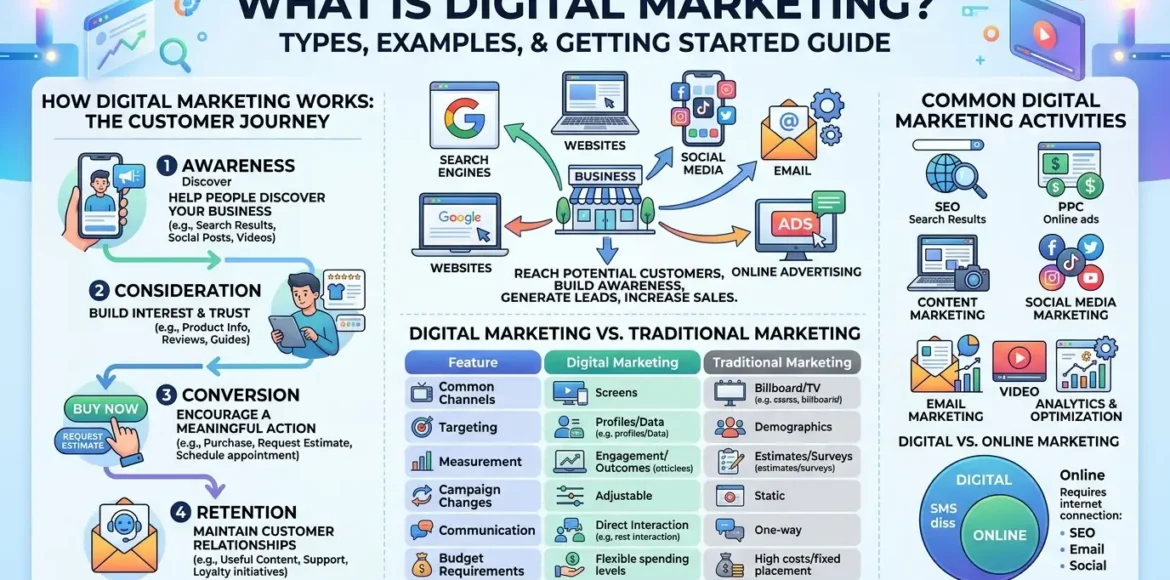
Digital marketing helps businesses reach potential customers, build brand awareness, generate leads, and increase sales through digital channels such as search engines, websites, social media, email, and online advertising.
Whether you are starting a small business, launching an online store, or learning marketing for the first time, understanding how digital marketing works can help you make smarter decisions about where to invest your time and budget.
However, digital marketing involves more than running Google Ads or posting on Instagram. An effective strategy combines audience research, useful content, the right marketing channels, and performance measurement.
In this beginner-friendly guide, you will learn what digital marketing is, its main types, how different channels work, and how to build a practical digital marketing strategy with real-world applications.
What Is Digital Marketing?
Digital marketing is the process of promoting products, services, or brands using digital technologies and communication channels to attract, engage, convert, and retain customers.
Businesses use digital marketing to connect with people who may be interested in what they offer. These connections can happen through Google searches, social media platforms, email campaigns, websites, videos, and mobile applications.
For example, imagine someone searching Google for “best roofing contractors in Dallas.” They discover a roofing company’s website, compare services, read customer reviews, and request an estimate.
The roofing business has used digital marketing to reach a potential customer during an important purchasing decision.
Digital marketing activities commonly include:
- Search engine optimization (SEO) to improve organic search visibility.
- Pay-per-click (PPC) advertising to attract relevant visitors through paid campaigns.
- Content marketing to educate and engage potential customers.
- Social media marketing to build awareness and customer relationships.
- Email marketing to communicate with subscribers and customers.
- Video marketing to explain products and demonstrate services.
- Analytics and conversion optimization to evaluate and improve results.
These activities can work together as part of a broader digital marketing strategy designed around specific business objectives.
Digital Marketing vs. Traditional Marketing
Traditional marketing generally relies on channels such as newspapers, television, radio, direct mail, and billboards. Digital marketing uses websites, connected devices, digital platforms, and related technologies to reach audiences.
| Feature | Digital Marketing | Traditional Marketing |
|---|---|---|
| Common channels | Search engines, websites, email, social media | Television, newspapers, radio, billboards |
| Targeting | Can use search intent, audience characteristics, and permitted data | Often uses geographic and audience estimates |
| Measurement | Digital engagement and tracked business outcomes | Audience estimates, surveys, and response tracking |
| Campaign changes | Often adjustable during a campaign | Depends on the advertising medium |
| Communication | Can support direct customer interaction | Frequently emphasizes one-way communication |
| Budget requirements | Options for different spending levels | Varies widely by channel and placement |
Neither approach is automatically more effective. Many businesses combine traditional and digital marketing to reach customers through multiple touchpoints.
Digital Marketing vs. Online Marketing
The terms digital marketing and online marketing are often used interchangeably, but they are not exactly the same.
Online marketing generally refers to promotional activities that require an internet connection, such as SEO, social media advertising, and email marketing.
Digital marketing is broader and can also include technologies such as SMS campaigns and certain digital displays.
How Does Digital Marketing Work?
Digital marketing works by connecting businesses with potential customers at different stages of their purchasing journey.
Customers do not always move through these stages in a fixed order, but the following framework helps explain how different marketing activities contribute to business growth.
1. Awareness: Help People Discover Your Business
The awareness stage begins when someone encounters your business through a search result, advertisement, social media post, video, or recommendation.
For example, a homeowner searching for landscaping ideas may discover an educational blog post published by a local landscaping company.
2. Consideration: Build Interest and Trust
During consideration, potential customers evaluate whether a business can solve their problems.
Helpful product information, service explanations, customer reviews, comparison guides, and transparent business details can support their decisions.
3. Conversion: Encourage a Meaningful Action
A conversion occurs when a visitor completes a valuable action, such as making a purchase, requesting an estimate, scheduling an appointment, or submitting an inquiry.
A clear offer, relevant landing page, and straightforward call to action can help customers complete the next step.
4. Retention: Maintain Customer Relationships
After a purchase, businesses can continue providing value through useful email communication, customer support, product information, and appropriate loyalty initiatives.
The goal is not simply to attract more visitors. It is to create a customer experience that supports meaningful business outcomes.
What Are the Main Types of Digital Marketing?
Digital marketing includes several channels and approaches. Each serves different purposes, and many businesses use multiple channels together.
1. Search Engine Optimization (SEO)
Search engine optimization (SEO) is the process of improving a website’s visibility in unpaid search results.
SEO helps search engines understand website content and helps users discover relevant information, products, and services.
The main areas of SEO include:
- Keyword research: Finding relevant searches and understanding search intent.
- On-page SEO: Improving page content, titles, headings, and other relevant elements.
- Technical SEO: Addressing crawling, indexing, site structure, and website performance issues.
- Local SEO: Improving a business’s ability to be discovered through relevant location-based searches.
- Off-page SEO: Earning relevant links, mentions, and recognition through legitimate activities.
For example, a Chicago plumbing company might publish service pages about emergency plumbing repairs and educational articles explaining common plumbing problems.
Relevant content can help the business appear for searches connected to its expertise and services, although search visibility is never guaranteed.
Businesses that want assistance with organic search visibility can explore Digital Markstar’s search engine optimization services.
For foundational technical guidance, see Google’s SEO Starter Guide.
2. Pay-Per-Click Advertising (PPC)
Pay-per-click advertising is an online advertising model where advertisers pay when someone clicks their advertisements.
Search advertising platforms, including Google Ads and Microsoft Advertising, allow businesses to advertise for relevant search queries.
For example, an online furniture store might run advertisements targeting searches for ergonomic office chairs.
When potential customers click an advertisement, they are directed to a relevant product page or landing page.
Advantages of PPC include the ability to test offers, control campaign budgets, and reach audiences through selected advertising placements.
However, successful campaigns require appropriate targeting, effective landing pages, conversion measurement, and careful spending decisions.
Businesses evaluating paid search campaigns can learn more about Google Ads management services.
3. Content Marketing
Content marketing focuses on creating and distributing useful, relevant information to attract and engage a defined audience.
Common content marketing formats include:
- Educational blog articles and tutorials.
- Case studies and research reports.
- Videos and webinars.
- Product comparisons and buying guides.
- Email newsletters.
- Infographics and downloadable resources.
For example, an accounting software company could publish an article explaining how small businesses can manage cash flow.
The content provides useful information while introducing the company to people researching a relevant business problem.
Effective content marketing prioritizes accurate information, reader needs, originality, and appropriate distribution.
Businesses planning educational articles, product descriptions, and website content can explore content writing services for additional support.
4. Social Media Marketing
Social media marketing uses platforms such as Facebook, Instagram, LinkedIn, TikTok, Pinterest, and YouTube to communicate with audiences and promote products or services.
It includes organic content, community engagement, customer communication, and paid social advertising.
A restaurant might use Instagram to share menu videos, while a business software company may use LinkedIn to publish industry insights.
Social media campaigns can support:
- Brand awareness and recognition.
- Customer engagement.
- Website traffic.
- Lead generation.
- Product discovery.
- Customer relationships.
Choosing the right social media platform depends on audience behavior and business objectives rather than popularity alone.
For businesses considering a coordinated approach, social media marketing services may help with content planning, campaigns, and performance evaluation.
5. Email Marketing
Email marketing involves sending relevant messages to customers and prospective customers through email.
Businesses use email marketing for newsletters, product announcements, onboarding, educational content, promotional offers, and customer retention.
For example, an ecommerce store might send order-related information after a purchase and provide relevant recommendations through a separate marketing campaign.
Email marketing can support direct customer relationships, but businesses must respect customer preferences, applicable privacy requirements, and commercial email rules.
In the United States, the CAN-SPAM Act establishes requirements for commercial email messages, including accurate sender information, nondeceptive subject lines, physical postal address information, and appropriate opt-out procedures.
Read the Federal Trade Commission’s CAN-SPAM compliance guide for official information.
6. Affiliate Marketing
Affiliate marketing is a performance-based approach where businesses compensate partners for specified results, such as qualifying sales or referrals.
For example, a technology publisher might recommend a software product through a tracked affiliate link.
If a visitor makes a qualifying purchase, the publisher may receive a commission under the affiliate program’s terms.
Affiliate relationships should be disclosed clearly when required, and recommendations should be accurate and useful to readers.
7. Influencer Marketing
Influencer marketing involves collaborating with content creators who have established audiences on digital platforms.
Brands may work with creators to demonstrate products, explain their features, or introduce services to relevant communities.
For example, a fitness equipment company might collaborate with a creator who publishes exercise tutorials.
Audience relevance, authenticity, credibility, and transparency matter more than follower counts alone.
The FTC provides guidance on influencer disclosures for material relationships between creators and brands.
8. Video Marketing
Video marketing involves creating videos to inform, educate, entertain, or persuade an audience.
Businesses use short-form videos, product demonstrations, tutorials, customer stories, and webinars to communicate information visually.
For example, a furniture brand could create an assembly demonstration that helps customers evaluate a product before purchasing it.
Video marketing can support several channels simultaneously, including social media, website content, advertising, and search visibility.
9. Display and Remarketing Advertising
Display advertising uses visual advertisements across participating websites, applications, and digital platforms.
Remarketing can help businesses reconnect with relevant audiences who previously interacted with their website or advertising, subject to platform rules, data availability, consent, and applicable privacy requirements.
These approaches can support awareness and consideration, but effectiveness depends on targeting, advertising quality, frequency, and measurement.
Digital Marketing Channels Comparison
| Channel | Primary Use | Main Advantage | Main Limitation |
|---|---|---|---|
| SEO | Organic search visibility | Reaches people researching relevant topics | Requires ongoing effort; rankings are not guaranteed |
| PPC Advertising | Paid customer acquisition | Can reach users through relevant paid placements | Requires advertising budget and optimization |
| Content Marketing | Education and audience engagement | Supports multiple customer journey stages | Requires useful content and distribution |
| Social Media | Awareness and engagement | Enables audience interaction | Organic reach and performance vary |
| Email Marketing | Retention and communication | Direct communication with contacts | Requires responsible contact management |
| Affiliate Marketing | Partner-driven referrals | Can compensate partners for defined outcomes | Requires program oversight and transparency |
| Video Marketing | Education and product demonstration | Explains visual concepts effectively | Production and distribution require resources |
Key takeaway: No single digital marketing channel works best for every business. Channel selection should depend on your audience, objectives, resources, and customer buying journey.
What Are the Benefits of Digital Marketing?
Digital marketing provides opportunities for businesses to connect with customers, improve visibility, and evaluate promotional activities.
1. Reach Relevant Audiences
Digital channels allow businesses to communicate with people based on their searches, interests, location, or other permitted targeting criteria.
For example, a business serving customers in a specific US city may choose advertising placements relevant to that service area.
2. Measure Campaign Performance
Analytics tools can help businesses understand website traffic, customer engagement, inquiries, purchases, and other activities.
This information supports better decisions when the measurements are accurate and interpreted correctly.
3. Test and Improve Marketing Activities
Marketers can compare advertising messages, landing pages, creative assets, and offers to understand which approaches perform more effectively.
Changes should be based on meaningful evidence rather than isolated metrics.
4. Support Different Business Budgets
Digital marketing offers options for organizations with different budgets. A small business might initially focus on a useful website and focused content before expanding into paid campaigns.
However, even activities without large advertising expenses require time, knowledge, and resources.
5. Build Long-Term Customer Relationships
Through relevant communication and helpful information, businesses can continue engaging with customers after the first purchase.
This may support repeat purchases, customer satisfaction, and stronger brand relationships.
What Are the Challenges of Digital Marketing?
Digital marketing also involves competition, changing platform policies, advertising expenses, privacy considerations, and measurement limitations.
Organic rankings are not guaranteed, paid advertisements do not automatically create profitable sales, and analytics reports may not capture every customer interaction.
For sustainable results, businesses need realistic expectations, reliable information, and a strategy that can adapt to changes.
Digital Marketing Examples for Different Businesses
The following hypothetical scenarios demonstrate how different businesses could apply digital marketing. They are educational examples rather than actual Digital Markstar client results.
Example 1: Local Home-Service Business
Imagine an HVAC company serving homeowners in Dallas, Texas.
Its main objective is to generate relevant installation and repair inquiries.
A possible digital marketing approach includes:
- Creating informative heating and cooling service pages.
- Maintaining an accurate Google Business Profile if eligible.
- Publishing helpful maintenance articles.
- Testing paid search campaigns for relevant services.
- Tracking phone inquiries, appointments, and acquired customers.
The company should evaluate the quality of leads rather than judging success only by website traffic.
Example 2: Ecommerce Clothing Store
Consider an online clothing retailer serving customers across the United States.
Its objective is to generate profitable purchases and encourage appropriate repeat engagement.
The business could combine product-focused search visibility, social media videos, relevant advertising, helpful size guides, and email marketing.
For an online retailer, product pages, clear delivery information, accurate images, and an easy checkout process are important parts of the customer experience.
Businesses building an online storefront may also consider appropriate ecommerce platforms and Shopify website development as part of their digital foundation.
Example 3: B2B Software Company
Imagine a company selling cybersecurity software to US businesses.
Its potential customers may need technical information, product demonstrations, and internal approval before purchasing.
A suitable marketing approach could include educational articles, search visibility, relevant LinkedIn content, product webinars, and follow-up communication with interested prospects.
The company would measure qualified leads, product demonstrations, sales opportunities, and acquired customers.
These scenarios show that digital marketing strategies must reflect different purchasing behaviors and business models.
How to Create a Digital Marketing Strategy: Step-by-Step
A digital marketing strategy explains how a business plans to reach its target audience, communicate its offer, and achieve measurable objectives.
Use the following steps to create a practical starting plan.
Step 1: Define Your Marketing Goals
Begin with a clear business objective.
Instead of simply saying “increase website traffic,” consider a goal such as generating more qualified appointment requests over the next quarter while monitoring acquisition costs.
Common objectives include:
- Increasing relevant brand awareness.
- Generating qualified business inquiries.
- Growing online sales.
- Improving customer retention.
- Reducing customer acquisition costs.
Define an appropriate performance metric for each objective.
Step 2: Identify Your Target Audience
Understand who your customers are, what challenges they face, and how they research solutions.
Useful questions include:
- Who is most likely to need your product or service?
- What problems are customers trying to solve?
- Where do potential customers research solutions?
- What information do they need before purchasing?
- What concerns might stop them from becoming customers?
Use actual customer conversations, search-query information, business records, and available analytics rather than relying entirely on assumptions.
Step 3: Research Your Competitors
Review competing businesses to understand how they communicate their services, organize website content, and reach potential customers.
Examine relevant search results, content formats, pricing information where available, audience questions, and customer concerns.
The objective is not to copy competitors. Instead, identify useful opportunities to explain topics more clearly or provide information that your intended audience needs.
Step 4: Select Suitable Digital Marketing Channels
Choose channels that align with your audience and business objectives.
A local service business may prioritize search visibility, while a visually oriented consumer brand may evaluate video marketing and social platforms.
Starting with a few coordinated channels is often more manageable than investing in every platform simultaneously.
Step 5: Prepare Your Website and Landing Pages
Before launching campaigns, make sure your website communicates what you offer and provides a straightforward next step.
Review:
- Clear page headings and service descriptions.
- Mobile usability and navigation.
- Relevant product or service information.
- Trustworthy business details and accurate claims.
- Working contact forms and checkout functionality.
- Appropriate conversion tracking.
A relevant landing page helps visitors understand whether your offer suits their needs.
Step 6: Establish Your Marketing Budget
Your budget should account for more than advertising spend. Depending on the campaign, costs may include content creation, website improvements, design, software, analytics, and management.
For example, the following is a hypothetical $2,000 test budget for a service business:
| Activity | Budget |
|---|---|
| Paid search advertising | $1,200 |
| Landing page and content improvements | $400 |
| Measurement and tracking setup | $200 |
| Testing reserve | $200 |
| Total | $2,000 |
Note: These amounts are illustrative planning figures, not average US marketing costs or recommended spending levels.
Step 7: Launch and Monitor Your Campaigns
Before launching, confirm that website forms, advertisements, landing pages, and essential measurement tools function correctly.
Monitor campaign performance using metrics appropriate to your objective, such as qualified inquiries, sales, acquisition costs, and customer value.
Step 8: Evaluate and Improve Results
Review what is working and what needs attention.
For example, if advertisements attract visitors but generate few qualified inquiries, investigate the audience targeting, offer, landing page, or conversion process.
Successful optimization involves identifying problems, testing reasonable improvements, and evaluating whether business results improve.
How to Choose the Right Digital Marketing Channels
The right channels depend on your customers’ needs, available resources, and business objectives.
Use this comparison as a starting point:
| Business Goal | Channels to Evaluate | Important Consideration |
|---|---|---|
| Generate local inquiries | Local SEO, paid search | Search demand and lead quality |
| Increase ecommerce sales | Product search, paid ads, email | Profit margins and purchase tracking |
| Build brand awareness | Social media, content, video | Audience relevance and engagement |
| Generate B2B leads | SEO, educational content, LinkedIn | Buyer research and sales cycle |
| Encourage repeat purchases | Email, CRM, relevant remarketing | Customer preferences and retention |
For example, paid search may be useful when customers are already looking for a service. Educational content may be more suitable when people need to understand a complex solution before considering a purchase.
Choose channels based on evidence and adjust your approach as you learn what produces useful results.
How Do You Measure Digital Marketing Success?
Digital marketing performance should be measured using metrics that reflect meaningful business outcomes.
Website traffic and advertisement clicks can be useful indicators, but they do not necessarily mean a campaign is profitable.
Important Digital Marketing KPIs
| Metric | Meaning | Purpose |
|---|---|---|
| Impressions | Number of times content or ads are displayed | Evaluate exposure |
| Click-through rate (CTR) | Clicks divided by impressions | Evaluate how often exposure leads to clicks |
| Conversion rate | Conversions divided by a defined activity measure | Evaluate desired actions |
| Cost per click (CPC) | Advertising spend divided by clicks | Measure average click cost |
| Cost per lead (CPL) | Relevant marketing costs divided by leads | Evaluate lead-generation cost |
| Customer acquisition cost (CAC) | Defined acquisition costs divided by new customers | Assess customer acquisition economics |
| Return on ad spend (ROAS) | Attributed revenue divided by ad spend | Compare attributed revenue with advertising spend |
| Return on investment (ROI) | Net return relative to investment | Evaluate financial return |
Example: Calculating Digital Marketing Performance
Consider a fictional service business running a paid advertising campaign.
| Metric | Result |
|---|---|
| Advertising spend | $1,200 |
| Total inquiries | 60 |
| Qualified inquiries | 24 |
| New customers | 6 |
| Revenue per customer | $600 |
| Total attributed revenue | $3,600 |
Cost per inquiry: $1,200 ÷ 60 = $20.
Advertising cost per acquired customer: $1,200 ÷ 6 = $200.
Return on ad spend: $3,600 ÷ $1,200 = 3.0, or $3 in attributed revenue for each $1 spent on advertising.
However, a ROAS of 3.0 does not automatically mean the campaign is profitable.
For example, if each of the six customers costs $350 to serve, variable service costs total $2,100. After subtracting those costs and the $1,200 advertising spend from $3,600 in revenue, only $300 remains before other marketing costs, labor, overhead, and expenses.
All figures in this example are hypothetical and are provided only to demonstrate marketing calculations.
Businesses should connect marketing performance with actual sales records and costs rather than relying only on advertising dashboards.
Essential Digital Marketing Tools for Beginners
Digital marketing tools help businesses research audiences, manage campaigns, publish content, and evaluate performance.
The best starting tools depend on the business goal and the information you need.
Google Search Console
Google Search Console helps website owners monitor their presence in Google Search.
It provides information about search queries, clicks, impressions, indexing, and other search-related matters.
Google Analytics 4
Google Analytics helps businesses understand website and app activity.
GA4 allows businesses to identify valuable actions as key events. Reporting and attribution settings should be configured according to the organization’s measurement requirements.
Google Ads
Google Ads provides tools for creating and managing eligible paid advertising campaigns across Google advertising placements.
Advertisers can monitor campaign costs, interactions, and reported outcomes.
Google Business Profile
Eligible businesses can use Google Business Profile to manage information that appears in Google Search and Maps.
Maintaining accurate business details can help customers understand services, locations, and contact options.
Keyword Research and Content Tools
Tools such as Semrush, Ahrefs, and Google Keyword Planner can support keyword research and competitive analysis.
However, search volume, competition metrics, and traffic estimates are approximations that should be interpreted carefully.
Email and CRM Platforms
Email marketing platforms and customer relationship management systems help businesses organize communication, manage customer information, and understand the progress of relevant sales opportunities.
Before adopting any tool, review its current pricing, limitations, privacy features, and suitability for your business.
How Much Does Digital Marketing Cost?
Digital marketing costs depend on the channels selected, campaign complexity, competition, content requirements, available expertise, and business goals.
There is no universal monthly budget that guarantees successful results.
Common cost categories include:
- Advertising spend.
- Website development and maintenance.
- Content creation and design.
- SEO implementation and management.
- Analytics and tracking setup.
- Software subscriptions.
- Agency or specialist fees.
A small business with limited resources might begin by improving its website and publishing relevant content, then evaluate paid campaigns when the business can support the additional costs.
The most appropriate budget depends on customer value, available margins, expected acquisition costs, and operational capacity.
How Long Does Digital Marketing Take to Show Results?
Results depend on the marketing channel and what the business defines as success.
Paid campaigns may begin attracting visitors after launch and approval, but testing and optimization may be necessary before their business value becomes clear.
SEO generally requires sustained work to develop and evaluate organic visibility. Rankings and traffic growth are not guaranteed.
Email campaigns may generate responses relatively quickly when a business already has a relevant, engaged audience.
Brand awareness, customer relationships, and content marketing may produce benefits over longer periods.
Set reasonable milestones and evaluate meaningful results rather than assuming every channel will produce immediate sales.
Common Digital Marketing Mistakes to Avoid
1. Choosing Platforms Without Research
Not every popular platform is suitable for every business. Research customer behavior and select channels that match your objectives.
2. Ignoring Search Intent
Publishing content without understanding what users want may attract irrelevant visitors.
For SEO, distinguish informational searches from product comparisons, service searches, and purchase-oriented queries.
3. Focusing Only on Website Traffic
High traffic does not necessarily create business growth.
Evaluate relevant engagement, qualified inquiries, customer acquisition, and revenue where applicable.
4. Using Weak Landing Pages
A confusing landing page can undermine otherwise relevant marketing activity.
Provide useful information, clear navigation, trustworthy claims, and an appropriate next step.
5. Publishing Content Without Added Value
Repeatedly publishing generic articles that merely rephrase competing content may fail to address readers’ needs.
Prioritize accurate explanations, original examples, meaningful comparisons, and information based on genuine expertise whenever available.
6. Ignoring Campaign Measurement
Without appropriate measurement, businesses may struggle to determine which activities contribute to meaningful outcomes.
Choose useful KPIs, verify tracking systems, and compare digital reports with real business records.
7. Expecting Guaranteed Results
No legitimate digital marketing strategy can guarantee a particular Google ranking, advertising return, or number of sales.
Performance depends on many factors, including competition, customer demand, the offer, budget, and execution.
How Is Artificial Intelligence Changing Digital Marketing?
Artificial intelligence is influencing how businesses research audiences, organize information, draft content, analyze marketing data, and manage selected advertising workflows.
AI-assisted systems can support tasks such as developing content ideas, summarizing research, analyzing available campaign information, and automating certain repetitive activities.
However, AI-generated outputs require review for accuracy, originality, privacy, suitability, and potentially misleading claims.
AI Search and Digital Marketing
AI-powered search experiences, including Google’s AI Overviews and AI Mode, can influence how users explore topics and discover information.
Website owners should continue focusing on useful content, technical accessibility, trustworthy information, and clear explanations.
According to Google Search Central’s guidance on AI features, standard SEO best practices remain relevant, and no additional special optimization is required for eligibility in these AI search experiences.
Businesses should approach emerging marketing technologies as tools to evaluate rather than shortcuts that guarantee visibility.
Frequently Asked Questions About Digital Marketing
What Is Digital Marketing in Simple Words?
Digital marketing means promoting a business through digital channels such as websites, search engines, social media, email, and online advertising. It helps businesses connect with potential customers and encourage relevant actions.
What Is the Main Purpose of Digital Marketing?
The main purpose of digital marketing is to help businesses achieve objectives such as awareness, customer engagement, lead generation, sales, and retention through relevant digital communication.
What Are the Main Types of Digital Marketing?
The main types include SEO, paid advertising, content marketing, social media marketing, email marketing, affiliate marketing, influencer marketing, video marketing, and display advertising.
What Is the Difference Between SEO and PPC?
SEO focuses on improving visibility in unpaid search results, while PPC is an advertising model where businesses pay for clicks. SEO requires sustained effort and does not guarantee rankings. PPC requires advertising spend and is affected by targeting, competition, and campaign quality.
Which Digital Marketing Channel Is Best for Small Businesses?
The best channel depends on the business type, customer behavior, goals, budget, and available resources. Local service companies may evaluate local SEO and paid search, while ecommerce businesses may consider product search, social media, paid advertising, and email marketing.
Can I Start Digital Marketing Without a Large Budget?
Yes. Businesses can begin by improving their websites, researching customer needs, and creating relevant content. However, these activities still require time and expertise, and they do not guarantee sales or organic traffic.
Can Digital Marketing Work Without a Website?
Some marketing activities can operate through social media platforms, marketplaces, or third-party services. However, a website can provide a central place for detailed business information, customer inquiries, ecommerce transactions, and measurement.
How Long Does Digital Marketing Take to Work?
The timeline varies by channel and business objective. Paid campaigns may begin delivering traffic after launch, while SEO and content marketing often require sustained effort. The time needed to achieve meaningful business results depends on competition, execution, customer demand, and other factors.
Is Digital Marketing a Good Career?
Digital marketing offers career paths in SEO, advertising, analytics, content strategy, social media, email marketing, and related areas. Opportunities, salaries, and career progression vary by specialization, experience, employer, and location.
How Can Beginners Learn Digital Marketing?
Beginners can start by learning marketing fundamentals, studying reputable platform documentation, and practicing skills through small projects. Understanding customers, search intent, content creation, advertising, and analytics provides a useful foundation.
What Are Important Digital Marketing Trends?
Areas worth monitoring include AI-assisted workflows, evolving search experiences, first-party customer relationships, privacy-conscious measurement, and changes in advertising platforms. Businesses should evaluate developments according to verified capabilities and actual customer needs.
Final Thoughts: Getting Started With Digital Marketing
Digital marketing gives businesses multiple ways to connect with customers, communicate useful information, and support measurable objectives.
Search engine optimization, paid advertising, social media, email marketing, content creation, and analytics each serve different purposes. An effective strategy combines the channels that make sense for the business rather than attempting to use every platform.
If you are just getting started, focus on understanding your audience, setting realistic goals, creating useful content, and tracking business outcomes.
The most valuable digital marketing approach is not necessarily the most complicated. It is the one that addresses genuine customer needs and helps the business make informed decisions.
Explore Digital Marketing Solutions With Digital Markstar
If your business needs assistance with online visibility, website development, organic search, paid advertising, or social media, explore Digital Markstar’s digital marketing services to learn about the available options.
You can also contact Digital Markstar to discuss your business goals, current challenges, and the marketing channels that may be appropriate for your needs.